Two assistants, one chat: routing every message with a small classifier
My chat has two AI assistants with different personalities. Every message needs a router that decides who answers. Keyword rules got it wrong half the time. A small local model, given the last few turns, got it right more than four times in five, in about 50 ms.
My personal AI assistant setup has two assistants in one chat. One is analytical and terse. The other is friendly and chatty. I like having both. But every message I send raises a small question first: who should answer? One of them, or both?
It needs an answer in milliseconds, on every message. This is how I moved that answer from rules to a small classifier.
Rules first
I started with the obvious rules. An @-tag picks an assistant. A name at the start of the message picks that assistant. Otherwise, stick with whoever was picked last.
They broke on the most common message of all: a reply. “Sounds good.” “Do that.” “Wait, why?” None of these name anyone. They are answers to whoever spoke last, and the rules had no idea who that was. Topic hand-offs broke them too. I would be talking to the analytical one about a bug, then say “anyway, what should we do this weekend?”, and the rules kept sending it to the bug fixer.
What we tried
I hand-labelled 46 turns from my own real chats. Each one got a label: assistant A, assistant B, both, or undecided. The set stays private. Then I ran every option I could think of against it.
| Option | Accuracy | Latency | Runs |
|---|---|---|---|
| Keyword rules (name or @-tag, else default) | 37-44% | ~0 ms | local |
| Rules + “else last speaker” | 67% | ~0 ms | local |
| Gemma 3 4B, zero-shot, calibrated | 52% | fast | local |
| Arch-Router 1.5B (a topic router) | 33% | 66 ms median, 112 ms p90 | local |
| Gemma 4 26B MoE (few active params) | 83-85% | ~50-200 ms median, warm | local, free |
| Claude Haiku | 93.5% | 2-3 s per call | cloud, paid |
| Claude Sonnet (batched) | 93.5% | ~12 s per 46-turn batch | cloud, paid |
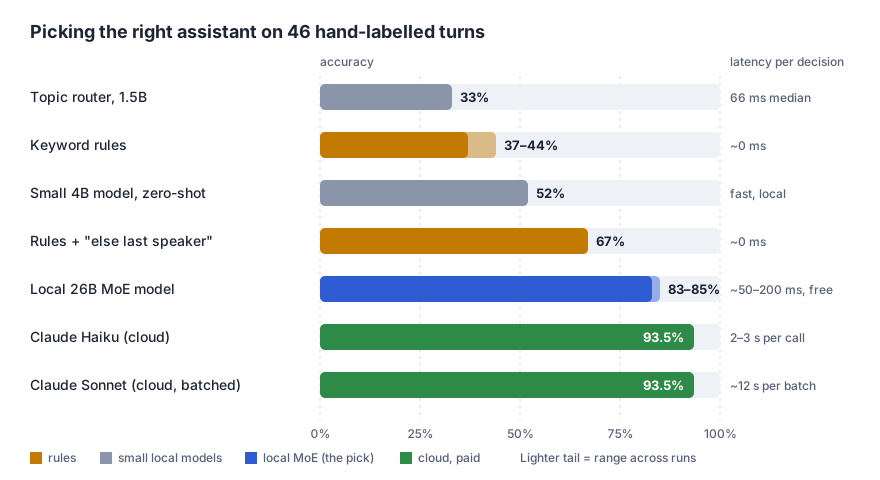 Accuracy and latency for every option I tried
A few things surprised me.
One extra rule beat two models. Adding “else, reply goes to whoever spoke last” took the rules from about 40% to 67%. That one line knew more about conversation than the small models did.
Small zero-shot models are option-biased. The 4B model loved one label. In one run it picked “both” on 41 of 46 turns. Calibrating it helped, but only to 52%.
The topic router was the worst. It is a fast 1.5B model trained to route requests. But it routes by topic and intent, and it answered its catch-all “other” on half the turns. “Sounds good” has no topic. It is a reply, and the router never learned who it replies to.
The cloud models were the most accurate and too slow. Two to three seconds is fine for a one-off job, not for every message.
The local mixture-of-experts model was the sweet spot. It has about 26B parameters in total but only a few are active per token, so it runs on my Mac mini. Given the last few turns, it got 83-85% right, at about 50 ms median once warm, for free.
The lesson: routing in a conversation is about turn-taking, not topic. A general model that can see the last few turns beats a specialist that only sees the message.
Why a classifier, if an LLM gives one answer anyway?
Because a classifier gives you a probability for each label, not just one answer. With probabilities, I can set a confidence threshold. When the top label is not confident enough, the router says “undecided” and keeps the current pick instead of forcing a guess. And a classifier is cheap enough to run on every message, which a chatty model call is not.
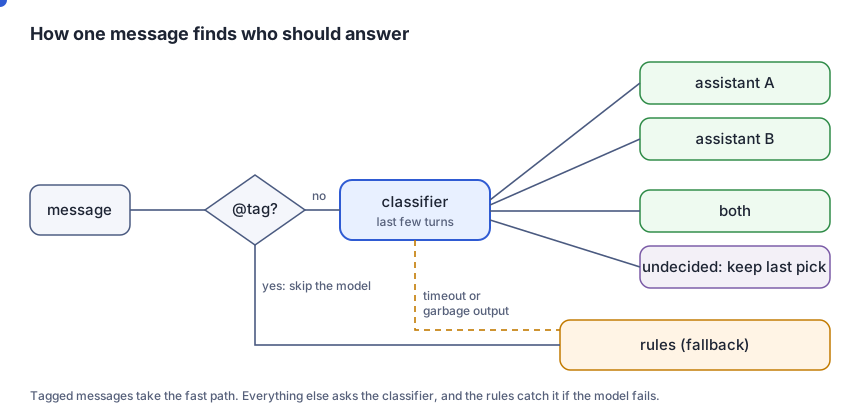 The path one message takes. The rules never go away; they catch every failure.
Built to grow
I asked for the code to stay modular, because this won’t be the only one. Every classifier is a named plug-in behind one interface: give it the text and the recent turns, get back a label or “don’t know”. A setting switches between rules and the model. @-tags skip the model entirely. If the model times out or returns garbage, the rules answer.
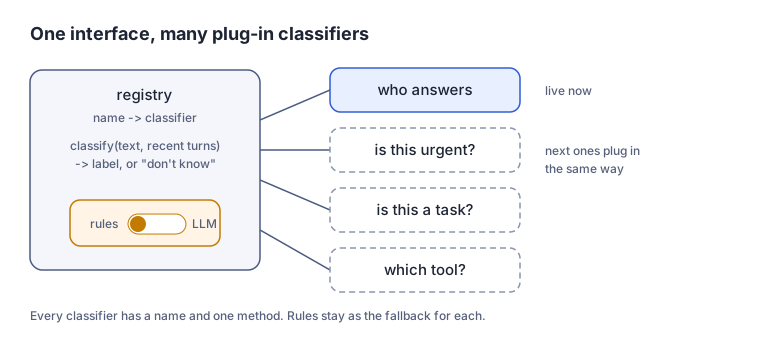 One interface, many classifiers. The next ones plug in the same way.
The next ones are already obvious: is this urgent, is this a task, which tool should handle it.
The bug a reviewer caught
While this was being merged, a reviewer found a good one. If I had explicitly picked an assistant, and the model then said “default”, the model’s default overrode my pick. Now an explicit pick wins, and the model only decides when nobody has.
What’s next
Few-shot prompting for the local model. Then the bigger idea: let the cloud models be the labellers. They are slow but accurate, which is exactly what you want from a teacher. Their labels can train a tiny model that is fast enough to run on every message and accurate enough that I stop noticing the router at all.