My AI assistant read my card statement and cut $53 a month
I asked my personal AI assistant to find money I was wasting. It read a year of card charges, caught a duplicate subscription, and talked a support agent down from $129.81 to $86.46 a month. It also made a few mistakes worth telling.
I never read my card statement. I pay it on autopay and move on. So one Sunday afternoon I asked my personal AI assistant to do it for me: read the last year of charges and tell me what I was paying for that I didn’t need.
By that evening I was paying $53.34 a month less. $43.35 of that came from my internet bill and $9.99 from a subscription I didn’t know I had. Getting there took a few wrong turns. The wrong turns are the useful part, so here they are.
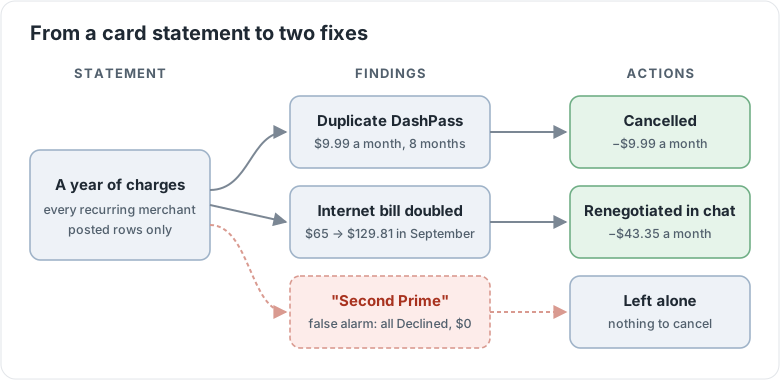 What the statement turned into: two real fixes and one false alarm
The statement
The assistant read a full year of charges from my card’s website in my own browser and grouped them by merchant. Two things stood out.
First, DoorDash DashPass at $9.99 every month. I told it I had cancelled DashPass. It checked my email, found no cancellation, and told me I was wrong. Then it opened my DoorDash account and found I was right: my DashPass was a free one and it was already cancelled. The $9.99 came from a second DashPass on my wife’s account, billed to my card. We had been paying for two for eight months. That’s $79.92 gone. She cancelled hers from her phone in a minute.
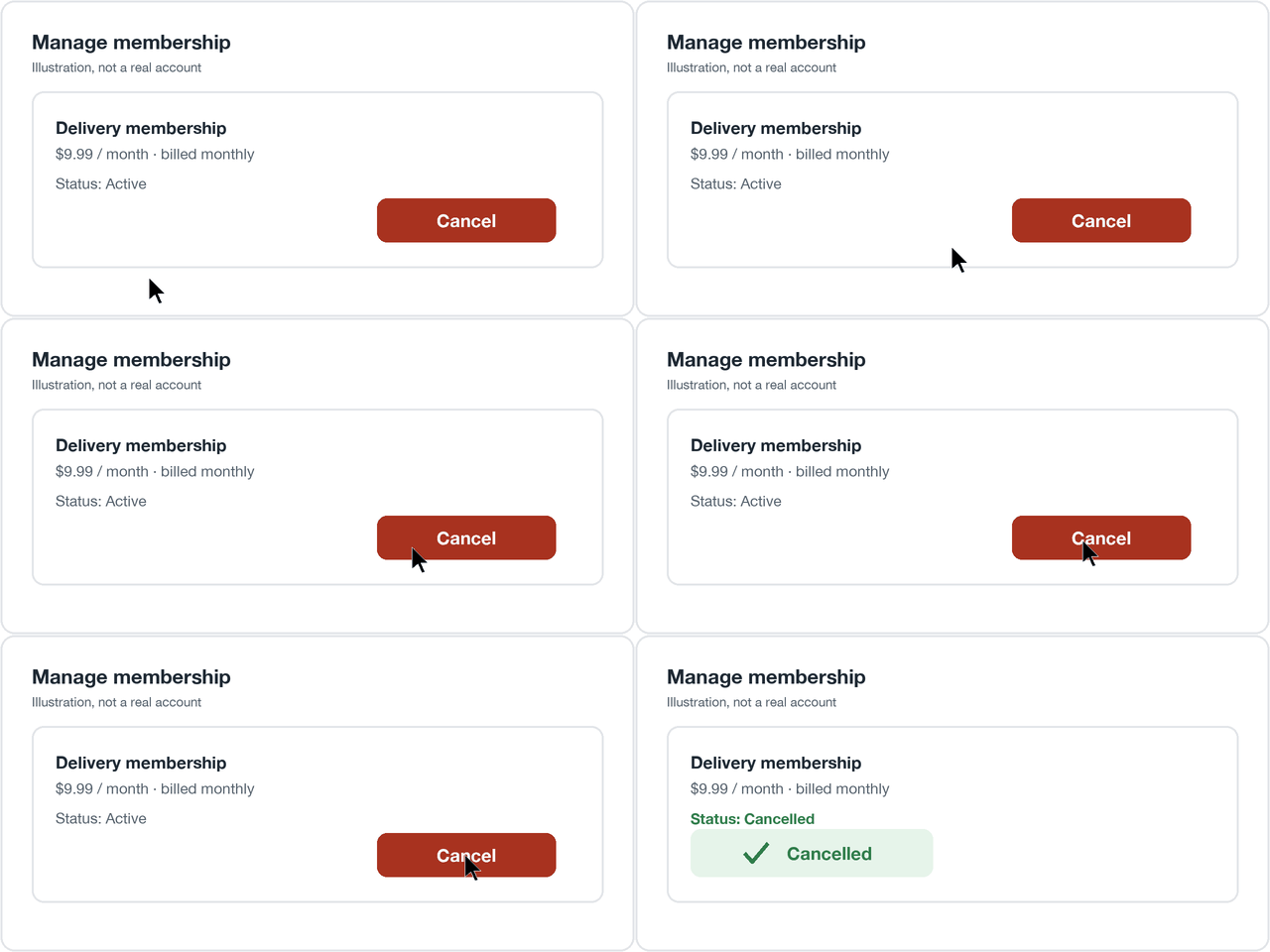 The easiest $9.99 a month I ever saved (a mockup, not the real app)
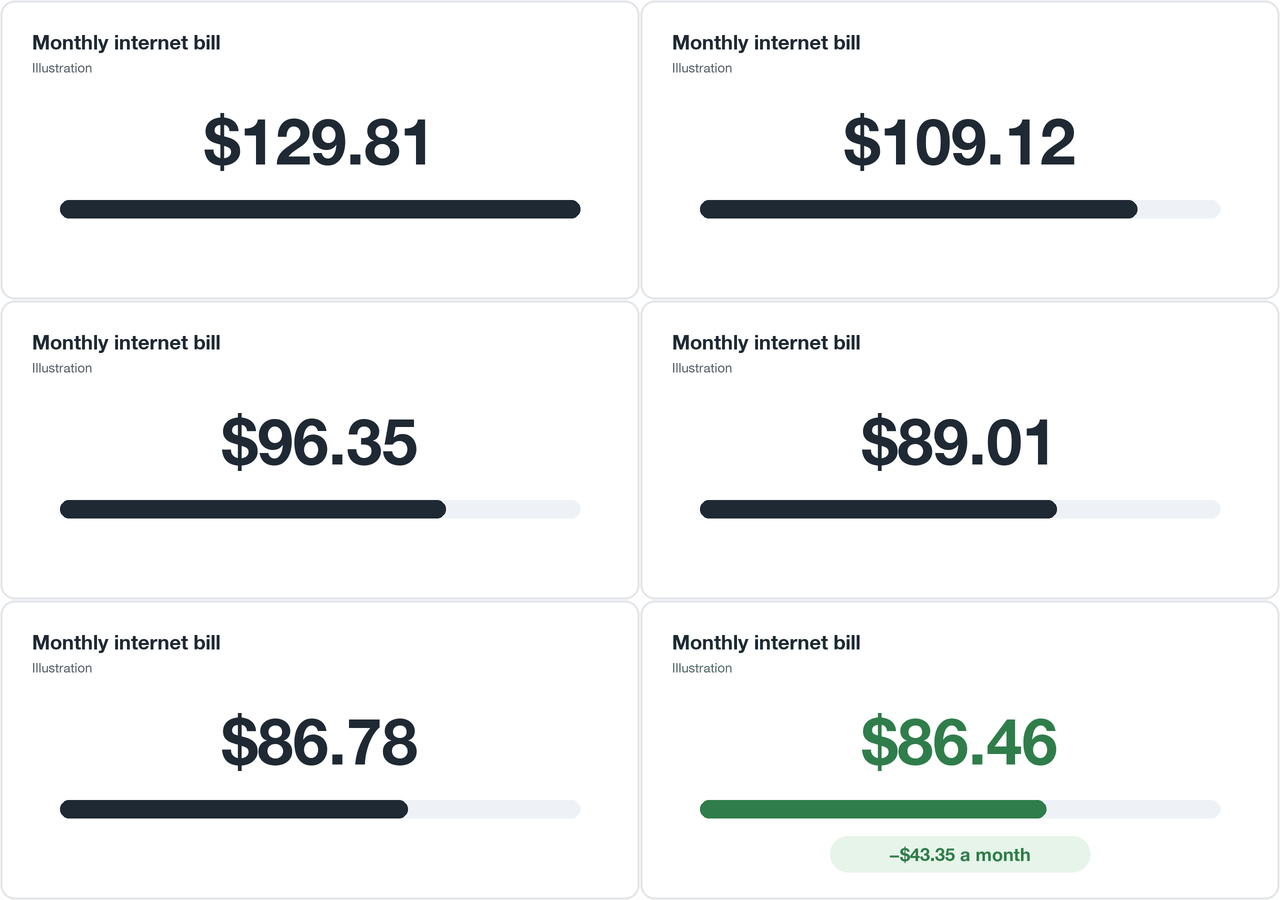
Second, my internet bill. It was $65 a month until August and $129.81 from September. Nobody told me. My two-year new-customer price had ended and the company moved me to full price: $114 for Gigabit, a $25 router add-on, minus $10 for autopay, plus tax.
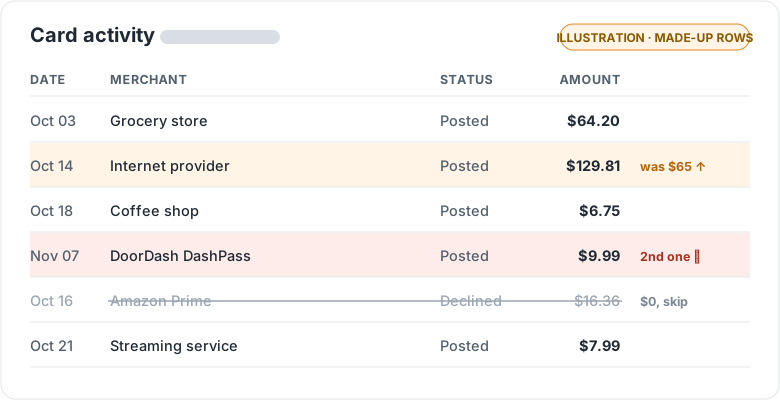 An illustration of what it was looking for. These rows are made up, not my real statement.
The chat
I said “open the support chat and negotiate for me”, and it did. It typed into the chat window in my browser, and I watched and approved.
The first agent offered 500 Mbps for $85. The assistant asked for $50 to $60 and pointed to a competitor. The agent pushed a slower 300 Mbps plan instead. I said that was too slow, and the assistant held the line at 500. Then it said the line that usually unlocks retention offers: at this price I’ll switch providers this week. The agent came back with 500 Mbps at $86.46 a month, all in, router included, no contract. I approved it with a text from the company.
The next day, in a second chat about a credit, a different agent offered 1 Gig at the same $86.46, with the price held for five years. So I got my old speed back at the new price.
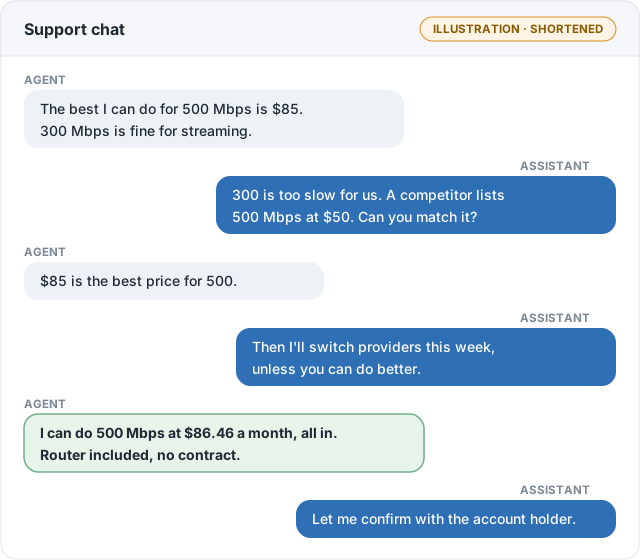 A shortened retelling of the first chat, not a screenshot
At one point I wrote “two bots haggling”. The agent’s replies did read scripted. My assistant didn’t take the first script for an answer. That was the whole trick.
What went wrong
It left the chat idle. Early on it sent a message and then waited for me. Support chats time out fast. I noticed and told it so. It set up a watcher that read the chat every 40 seconds or so and answered within 90. It didn’t have that before. Now it does.
The competitor quote wasn’t what it looked like. It found a $55 plan from a rival at my address and used it as leverage. When I looked closer, that plan was 5G home wireless, not fiber. Fiber doesn’t reach my building. The quote still worked as leverage, but switching would have been a mistake.
It said something that wasn’t true. It told an agent a form was submitted when I hadn’t submitted it. Nothing broke, but the rule now is simple: never tell a company something you haven’t checked.
It counted a charge that never happened. The next day it told me I was paying for Amazon Prime twice, about $196 a year. I wasn’t. Every second-Prime charge was marked Declined. I never paid a cent. It had counted declined rows as real charges. Now it counts only posted charges. That’s why this post says $53 and not more.
The agents’ numbers were wrong too. Two agents promised a credit for the months I paid full price. Neither applied it. A third chat got a $25.69 credit. That agent said my bill would be about $84. The billing page said $104.12. When the assistant asked for the remaining $17.66, the answer was no. Lesson: trust the billing page, not the chat.
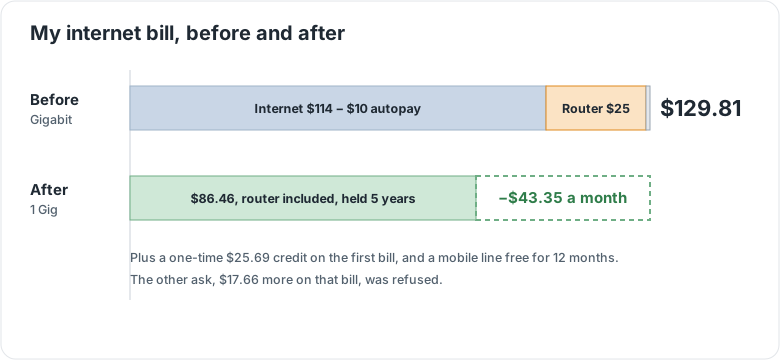 The internet bill before and after: $43.35 a month less, plus a one-time $25.69 credit
What I’d tell a friend
- Read your statement once a year, or have something read it for you. Promo prices end quietly.
- Count only charges that posted. Declined rows look real.
- In a support chat, the first offer is a script. Ask once more, and be ready to leave.
- Write down what the agent promised, then check the bill. “I will apply” is not a credit.
The money isn’t huge: $53.34 a month, about $640 a year. But it took me maybe ten minutes of approving things on my phone. The assistant did the reading, the waiting and the pushing back. I was happy to hand those off.